Thursday, January 13, 2011

Wine News: Oldest Winemaking Equipment Found!

Thank you to my dad who forwarded this article to me from Yahoo News, copied here for your reading convenience below.  (A full feature, more scientific article can be found at Science Daily).

Handout of archaeologist Petrosyan looking at ...
Oldest winemaking equipment found in modern day Armenia 
Photo from Yahoo News

This finding of the wine basin is the earliest known evidential winemaking artifact discovered, and its approximately 6000 years old!  The wine basin was surrounded with old desiccated wine seeds, stems, and berries.  Archeologists believe this basin was used for winemaking because at the time, there was no way to preserve juice of any kind.  Alcohol increased the longevity of such beverages, making them safe to consume for a long time without modern day refrigeration.   This cave was excavated in modern day Armenia, near the Iran border:


What an unique find for the wide world of wine!  Just a little something extra to store in your brain the next time you want to wow someone with wine facts.  :)

At 6,000 years old, wine press is oldest yet found

Yahoo article... see above link for Science Daily article
WASHINGTON (Reuters) – Archeologists have unearthed the oldest wine-making facility ever found, using biochemical techniques to identify a dry red vintage made about 6,000 years ago in what is now southern Armenia.
The excavation paints a picture of a complex society where mourners tasted a special vintage made at a caveside cemetery, the researchers reported on Tuesday in the Journal of Archaeological Science.
"This is the world's oldest known installation to make wine," Gregory Areshian of the University of California Los Angeles, who helped lead the study, said in a telephone interview.
Carbon dating showed a desiccated grape vine found near a wine presswas grown around 4000 BC, his team reported.
This makes it 1,000 years older than any other wine-making facility discovered, the team from Armenia, the United States and Ireland reported.
The team found the world's oldest leather shoe, about 5,500 years old, at the same cave complex last year.
The wine press would have held a few gallons of juice and crushed grapes, likely working with the time-honored technique of barefoot stomping, Areshian said.
"This was a relatively small installation related to the ritual inside the cave. For daily consumption they would have had much larger wine presses in the regular settlement," said Areshian, who was deputy prime minister in the first government of the independent Republic of Armenia in 1991.
Chemical traces point to grape juice and, given the lack of refrigeration, the juice would certainly have been fermented into wine, Areshian said.
"We also know that still, in the villages in the vicinity, the culture of wine is very old and traditional," he said.
The rich red wines produced there are merlots and cabernet sauvignons, he said.
The expedition, paid for in part by the National Geographic Society, also uncovered copper processing equipment. Areshian said the team would detail those findings later.
The cave complex, known as Areni-1, is in the Little Caucasus Mountains near Armenia's southern border with Iran.
The press itself is a shallow clay basin about three feet (one meter) in diameter, surrounded by grape seedsand dried-out grape vines.
The team found grave mounds nearby and obsidian tools -- indicating some complicated trade was going on. The closest source of obsidian, a black glassy mineral, is 35 to 45 miles away, a three-day walk, Areshian said.
"We can say that this was a quite complex society formed by multiple communities," he said.
(Editing by John O'Callaghan)

Wednesday, January 12, 2011

What's in My Glass Wednesdays! 2009 Cupcake Vineyards Chardonnay

Here's a wine brand that will make the invention of liquid cake seem real!  (Now you can have your cake... and drink it, too... please drink responsibly!)  Cupcake Vineyards has released several varieties throughout the nation.  I've found these wines in Florida, Massachusetts, and California.  I have a feeling their in your local region as well.

Photo from circleoffood.com

The wines are meant to be consumer appealing - everything from the name of the brand, the label, and the wine flavors.  The 2009 Chardonnay, for example, tastes like a vanilla cupcake.  Complete with some residual sugar and a nice mouthfeel, it's a real bargain - a whopping $12!  Other wine consumers have also recommended the Riesling, although I have not tasted this one myself.  

I once compared the 2009 Chardonnay to a $40 2009 Chardonnay from a well known Napa producer.  Although I can appreciate that the Cupcake brand was not complex, it sure did taste better, and can appreciate the overall satisfaction with the wine.  Go ahead and give this one a try the next time you're in for a crowd-pleasing Chardonnay.

BONUS:  The website includes several recipes that are paired with their wines.  LOVE this idea:
(recipe included from webpage for your convenience)
Ingredients
"Serves 4
2 tablespoons extra-virgin olive oil
1 pound red Swiss chard, stems trimmed and finely chopped, leaves coarsely chopped
1 garlic clove, minced Salt and freshly ground pepper
6 cups chicken stock or canned low-sodium broth
1 small onion, finely chopped
1 1/2 cups Arborio rice
6 ounces Gouda cheese, preferably made from goat's milk, shredded
1 tablespoon unsalted butter

 
 Directions 
1. In a large, deep skillet, heat 1 tablespoon of the olive oil until shimmering. Add the chopped chard stems and cook over moderately high heat, stirring frequently, until crisp-tender, about 4 minutes. Add the garlic and cook until fragrant, about 1 minute. Add the chard leaves and cook, tossing, until wilted, about 3 minutes. Drain the chard and transfer to a bowl. Season with salt and pepper. Wipe out the skillet.

2. In a saucepan, bring the stock to a simmer. Heat the remaining 1 tablespoon of oil in the skillet until shimmering. Add the onion and cook over moderate heat, stirring frequently, until softened, about 7 minutes. Add the rice and cook, stir- ring until the rice is coated with olive oil, about 2 minutes. Add 1 cup of the hot stock and cook, stirring frequently, until the rice has absorbed most of the stock, about 3 minutes. Continue to cook the risotto, adding 1 cup of stock at a time and stirring constantly between additions until the stock is absorbed. The risotto is done when it is creamy and the rice grains are just tender, about 20 minutes.

3. Remove the risotto from the heat and stir in the cheese, butter and cooked. Season with salt and pepper. Serve at once"


The D-2010 Scale 
2009 Chardonnay by Cupcake Vineyard (Livermore, California, USA) 
Appearance (10 points possible): golden yellow hue, clear - 10 points
Aroma/Bouquet (20 points possible): Vanilla, buttery notes of oak burst from the glass with underlying tones of apples, pears, and citrus.  Simple, yet alluring: The aroma immediately reminds you of a Chardonnay!  - 15 points
Taste (10 points possible): Medium- to full-bodied, smooth, with a perfect acidic balance that makes this wine melt on your tongue like cake.  Feels like a liquid piece of vanilla cake.  A light, sweet finish ends the wine with lingering flavors of vanilla.  - 8 points
Balance (5 points possible): Very well balanced.  The oak is designed to dominate this wine in flavor, but the fruit components are still there.  Nice sugar/acid balance, not to high in alcohol.  Very pleasant. - 5 points
Finish (5 points possible): Lots of oak-based flavors in the finish, especially vanilla.  The sweetness really makes this wine.  Although it is not super sweet, it definitely complements the style.  All around great package for the name of the brand and the flavor profile. - 5 points 
Add 50 points for attempt, packaging, closure, etc.
Total Points: 99
Overall Thought: I've had this wine so many times because it's easy to pair with foods, and beats buying a $25 - $40 Chardonnay when you need that "oaky Chardonnay" kick.  The slight sweetness is sometimes off-putting to me, because sometimes I want a dry wine, but really - can you beat a $12 wine?
Food Pairings: White based pastas, risotto, fried chicken (I don't know why, but this seemed to go fantastically with fried chicken...), turkey, fish, corn bread, cupcakes, cake... period, cookies, etc.
Cost: $12
Splurge Factor (out of 4): 1 - This wine is a real bargain for $12.  It's become so popular that I think it's worth the $12.  Many women are finding this their wine of choice.  What a great marketing idea!  A wine made for consumers... who would've thought?
Where to buy: Distributed nationally or order online if you can: Cupcake Vineyard.  Enjoy!

Photo from Google Images

Tuesday, January 11, 2011

Wine Books to Read: How to Launch Your Wine Career

I received this book as a birthday present from my parents.  While doing some wine book searches online, I came across this one: How to Launch Your Wine Career by Liz Thach, Ph.D., and Brian D'Emillo.  And although I thought the book may be slightly cheesy (enough to enjoy a glass of wine with... haha), I actually really enjoyed it and found it incredibly useful.  I wish someone would have put this book in my hands about 5 years ago to prepare me for the road ahead.
How to Launch your Wine Career: Dream Jobs in America's Hottest Industry
Photo from amazon.com

How to Launch Your Wine Career is written for the entire wine industry, but focuses more specifically in California.  And after working in several wine industries around the world, I'd have to confirm that if your region-of-interest is California, this is a good book to put your eyes on.  (P.S. Now available on Kindle...)

Best advice in the book was to spend at least a week in whichever region you would like to move to!  The outside of the California wine industry looks so romantic, but the inside is filled with busy schedules, incredibly long hours, lots of commuting/traveling, and a lot of networking.  I think this book really highlights what it feels like to work in the California wine industry from several angles and professions.  It's quite up front and honest about the realities and perks of working for a winery or the wine industry.  Not only does it lay out the steps involved to work your way up the ladder for several types of careers, but the key feature of this book is the interviews at the end of each chapter from individuals living the wine life. 

This book looks at careers in:
- The Vineyard
- As Winemaker
- Wine Marketing, Sales, and Public Relations
- Wine Writers and Educators
- Winery Administration
- Winery Supplier

The end of the book also allows you, the reader, to fill in blanks and create your own action plan if you are getting geared up to start your wine career.  I highly recommend this book to ANY college student looking to go into the California wine industry.  It profoundly lays out all the details to provide you with a successful future. 

Side note:  After reading several chapters, I recommended this book to an Assistant Winemaker that I see often.  He read the book and said the same thing:  He wishes he read it long ago!

P.S. Bonus points if you know which winery is on the cover!  I'll give you a hint... it's on Highway 29!  :)

Monday, January 10, 2011

Wine Packaging: FLASQ

I check a daily posting of wine news every Monday through Friday, and I found this one to be quite interesting.  JT Wines released its wine in 100% recyclable aluminum can last week.  Named FLASQ (which I am assuming is said like "flask"), the product is sold in 2 varieties: California Chardonnay and Merlot.  Each bottle contains 375 mL of wine (which is reported as 2 generous glasses of wine), sold for about $6 to $8 (economically thrifty), and targeted towards Millenials, Generation Xers, and Baby Boomers.  JT Wines released that the aluminum package chills 5 times quicker than a glass bottle, stays colder longer than a glass bottle, is resistant to breaking, prevents "light-shock" (which can cause sulfur/rotten-egg aromas/flavors in wines and beer), preserves flavor straight from the barrel, and allows for "additional aeration while drinking" (which is supposed to keep the wine fresher as you drink it).  They are said to hit grocery stores and distribution chains quickly. 

Photo from article

The attached article also lists some tasting notes for the first releases, which I have provided here for your reading convenience.  (For full article, please click here).

2009 FLASQ Chardonnay
- 100% Chardonnay (Monterey County)
- Rich pear and pineapple with a hint of butterscotch
- Medium-bodied wine with balanced fusion of lush fruit and refined acidity

2009 FLASQ Merlot
- 85% 2009 Merlot (San Luis Obispo County, Paso Robles) & 15% 2008 Merlot (Monterey County, San Antonio Valley)
- Ripe red and blackberries with a note of spice
- Medium-bodied wine boasting the union of verdant fruit and smooth tannins

I think both variety choices are wise: easy drinking, smooth, light, appeal to both men and women.  The price, when you think about it, is interesting (considering some wines you can buy 750 mL - twice as much - for $10 or less), the descriptions of the wines are quite marketing-oriented, the packaging is catchy for "on-the-go" consumers, and the idea: innovative (not traditional).  

Tell me what you think if you find one of these wines and try it!  Please post in the "Comments" section for today's blog.  Cheers. 

Friday, January 7, 2011

Wine Closures Uncorked!

I was doing a search online to start introducing my readers to some new, innovative packaging ideas for the wine industry, when my old packaging paper showed up online.  I got a small chuckle and then thought, "Why not share?"  (Click on the link below to access paper.)

Wine Closures - Photo taken by Sean O'Keefe at Virginia Tech

The paper is fairly old, and please forgive the rather poor use of the English language.  I wrote this paper over 5 nights from midnight through 4:30 in the morning while trying to maintain my classwork and graduate studies.  But it highlights an overview of wine corks and some new closures that were just being released into the market at the time, including the now famous Zork.  A year ago, someone picked it up on Twitter and I was very excited that I could be famous (...just kidding...).  However, my hope is that this small review on wine closures will give you a better idea of wine packaging.

Thursday, January 6, 2011

Travel Tip: Bridlewood Estate Winery

I wrote about Bridlewood's Arabesque Reserve yesterday, and I figured now would be a good moment to introduce the winery for those hoping to travel to California.  Bridlewood Estate Winery is located in the Santa Ynez Valley, which is several hours south of Napa Valley in the Central Valley.  

Bridlewood Estate Winery
Photo taken by author


It was a spontaneous find when "Johnny Depp" and I visited one of my college girlfriends at the beginning of this past summer.  She told us that she wanted to take us to her favorite winery close to where she lived.  Of course, we were game.  Much to our surprise, it has become one of our favorite wineries strictly because we can both find wines there that we both enjoy (even if it's for different reasons).

We went in the thick of summer, when temperatures were high and the sun was always out.  But it was worth it!  The driveway is adorned with a line of beautiful trees, which is breathtaking.  The Spanish-Mission-style winery itself is lovely with several roses planted throughout the estate, which is always highly attractive.  The interior is decorated with oak barrel tables for parties to enjoy their glasses of wine.  The tasting room staff was incredibly pleasant.  Our server talked to us for almost an hour and was very cheerful!  It was such a nice welcoming to a winery we had never visited before.  I believe you can taste 5 wines for a small fee, but in the tasting you received a Bridlewood wineglass, which is one of the best wineglasses I've ever received from a winery.  We have reserved our glasses for our regular wine drinking.  

Bridlewood Estate Driveway
Photo taken by author

Bridlewood Estate
Photo taken by author

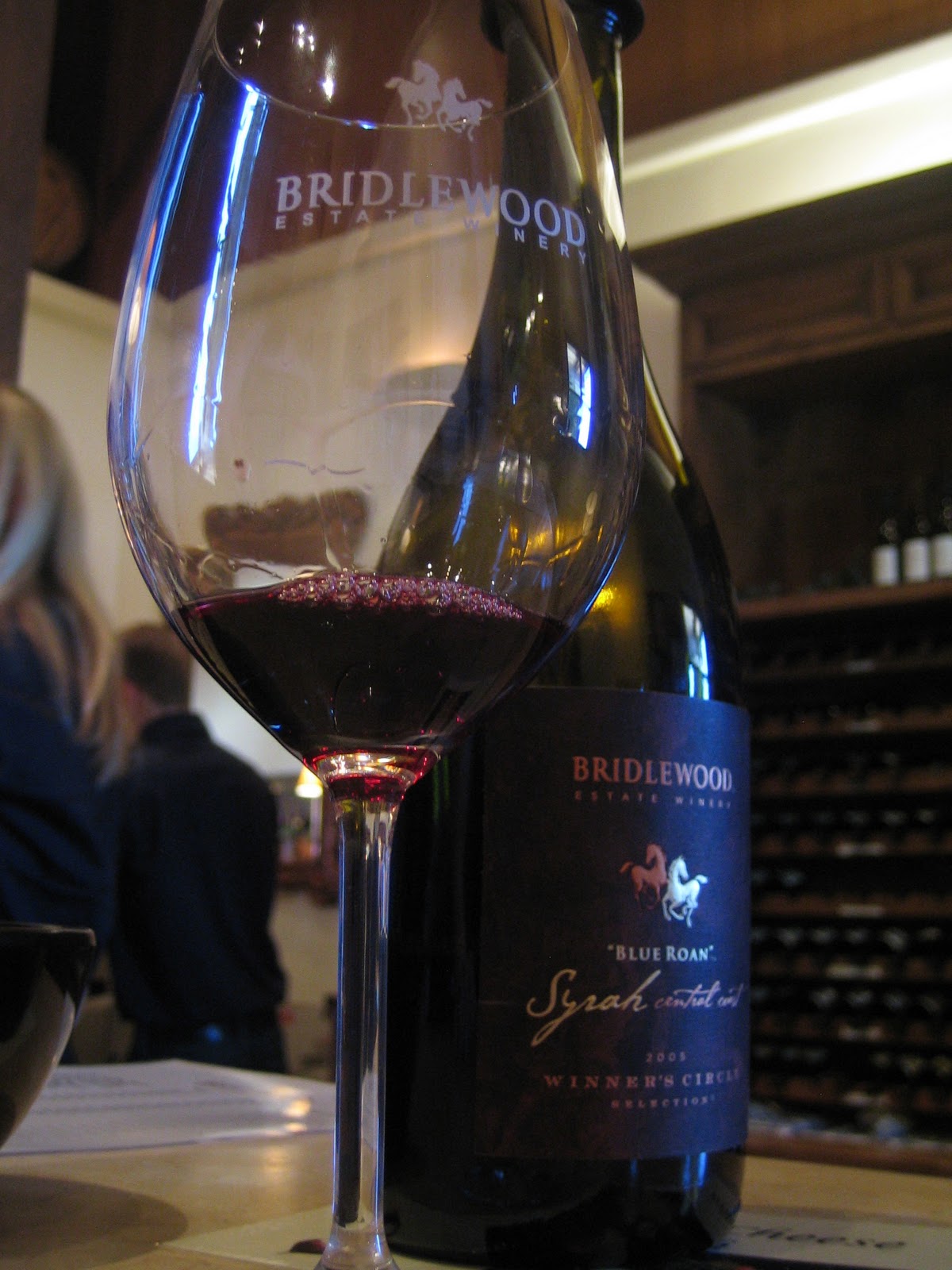
Wine Tasting at Bridlewood Estate Winery - Try their Syrahs!  (P.S. That's the wine glass
you get for tasting.)
Photo taken by author

Ultimate plus: the winery is close to many cute towns in the Central Valley, including Paso Robles and Los Olivos.  They're cute, quaint, and not overly crowded.  In Paso Robles, several wineries are positioned on 46.  You can make several days of wine tasting in Paso Robles.  Plus, the town square contains several fantastic restaurants.  (Villa Creek has to-die-for margaritas.)  In Los Olivos, grab some traditional California sandwiches at Paninos, walk through the town, and stop into several tasting rooms on their main road.  The day will surely be one to remember.  If you're ready to spend a day at the beach, you're close enough from Bridlewood to take a small trip to several California beach towns.  The options are endless!

Wednesday, January 5, 2011

What's in My Glass Wednesdays! 2007 Arabesque Reserve

For 2011, I'd like to sharpen up this blog site.  At some point this year, I will introduce a new theme and blog title.  But for now, I'd like to start the introduction of...
"What's in My Glass Wednesdays!"  
This will replace my "Wine Buzz" series that started the introduction and description of wines.  It's my hope that this will force me to write about more wines, even if my palate is dominated by California wines right now (I apologize to my readers that cannot purchase those due to distribution limitations.  But always check with your local wine store or distributor.  Sometimes they can import a wine for you.)  So without further ado:

2007 Arabesque Reserve by Bridlewood Estate Winery
Arabesque
The D-2010 Scale 
2007 Arabesque Reserve by Bridlewood Estate Winery (Santa Ynez Valley, California, USA) 
Appearance (10 points possible): ruby/garnet red - 10 points
Aroma/Bouquet (20 points possible): highly aromatic with hints of cherries, strawberries, raspberries, pomegranates, pineapples, citrus punch, peaches, and light notes of oak, cedar, smoky, vanilla, spice, earth and herbs.  The combination of red fruit and white fruit really make this Rhone style wine pop.  Neither red or white fruit dominate, but marry quite nicely.  The hints of oak massage the fruit into this beautifully created liquid heaven in the glass.  - 20 points
Taste (10 points possible): Medium-bodied with a layered complexity of fruit and oak.  The wine is fruity (red and white), has a slight sweetness on the tongue, with a balanced acidity mid-palate and lingering finish that reminds the drinker of red and white grapes.  A slight bitterness in the finish may linger for those sensitive, but I believe this is from the higher (14.2%) alcohol level.  - 10 points
Balance (5 points possible): The alcohol sticks out to me, as well as a slight ethyl acetate (volatile acidity) factors that renders the wine slightly unbalanced in my mind.  Otherwise, perfect. - 4 points
Finish (5 points possible): Lots of fruit and oak lingers in the finish.  It's the perfect wine to sip by itself or with a small, special meal where you need something light, fruity, and refreshing in the cold depths of winter or hot summer days. - 5 points 
Add 50 points for attempt, packaging, closure, etc.
Total Points: 99
Overall Thought: I love, Love, LOVE this wine.  It's an easy drinker and captures everything a white/red blend should - fruitiness, easy-drinking, overly enjoyable, a touch of sweetness, and some depth to complete the package.  My only regret is that I only bought one bottle of this wine from the winery.  How sad...
Food Pairings: light, white-based pasta, fish meals (except for salmon, lobster, or shrimp), light cheeses, Cannolis (yes, that's right... bet you wish you had a Cannoli right now, don't you?)
Cost: $10
Splurge Factor (out of 4): 1 - This wine is a steal for $10.  Are you kidding?  You can buy a bottle of Yellow Tail at that price and get something bone dry and one dimensional (I'm not knocking Yellow Tail... but sometimes you have to mix it up and make your wine dance for you!).  This wine is an unbelievable thrifty buy and it's something that you can take almost anywhere that either a man or woman will enjoy.  All around incredible buy!
Where to buy: Order online if you can (otherwise, I'm hoping it's distributed throughout the U.S.): Bridlewood Estate Winery

Tuesday, January 4, 2011

Wine Roots

Every now and again, I get nostalgic for the past that led me to Napa Valley.  Over my Christmas holiday this year, I decided to pick up some wine books that are sitting on my shelves and take them along to read.  One book, Pennsylvania Wineries by Linda Jones McKee and Richard Carey, was given to me when I visited my first winery in Pennsylvania, Adams County Winery, by the winemaker himself.  When my parents told him that I was starting an agricultural course in high school and that I was reading articles about grapes, he grabbed the book, which had just been published, off of the display table and put it in my hands.  He told me to read it and explore the Pennsylvania wine industry.  At that time, I had no idea what I was getting myself into.  I read the book then... and I read the book now.  

Pennsylvania Wineries can be purchased from amazon.com

Although the book is about 10 years out-dated, it captures the essence of the Pennsylvania wine industry and its roots.  Each winery has an incredible story behind it - how it started, why it started, and how it maintains business.  I encourage all Pennsylvania residents (and others!) to explore what is in their backyard.  Such fun things exist in the state - a Renaissance Fair, annual festivals at several wineries, hunting/fishing stops at wineries, Appalachian Trail hikes through wineries, and fun by all!

Some things have definitely changed for the state of Pennsylvania since the time of the book's publication.  For one thing, the book focuses on 53 of the wineries throughout the state.  Today, there are over 100.  In the past, the industry was just getting noticed.  Today, it has its own website: Pennsylvaniawine.com.  They are also included on Facebook and Twitter for all of us nostalgic locals to keep tabs on the industry.  And at the time of publication, the idea of having an actual castle on site at Sand Castle Winery was only a dream... today, a reality!

As the industry continues to grow, there are so many unique places for Pennsylvania residents to visit.  Here are just a few of my favorite stories from the book (in no particular order):

1) Allegro Vineyards was the original creator of Opus 1 wine, before Robert Mondavi filed a patent for his Opus One in California
2) Franklin Hill Vineyards is considered a model workplace for women, originally owned and operated by a group of local women while their children were in school
3) Chaddsford is one of the largest wineries in the state of Pennsylvania
4) Mazza Vineyards received national attention in 1974 for their Riesling, which was considered to be a Mosel, German Riesling in a blind competition
5) Stargazers Vineyard & Winery was named after the Mason-Dixon line surveyors, and has an environmentally friendly winery operation

There are so many more stories and fantastic wineries to visit in the state of Pennsylvania.  I wish I took the time to enjoy what the state had to offer me while I still lived there.  Please keep us all posted in the comment section of this blog if anyone visits a local winery and has a unique story to offer.

The look of Pennsylvania wine:

Photo from Mazza Wines

Chaddsford Winery
Photo from Chaddsford Winery

Adams County Winery's picturesque farm, located in Orrtanna PA

Slideshow Image 1

Photo from Sand Castle Winery

And much, much more...

Monday, January 3, 2011

Virginia Tech Awarded Millions to Enhance Eastern Wine Industry

Another wonderful piece of good news in the Eastern Wine Industry:


Congratulations to Virginia Tech and the collaborative universities on their accomplishments.  As an alum, I can officially say, I'm quite proud.  :)  Please remember if you are from the Eastern U.S., do not be afraid to explore your local wineries.  There are some real gems out there.  And it stimulates the local economy, which we could all use these days.

This article has been attached for your convenience:
BLACKSBURG, Va., Oct. 29, 2010 – The U.S. Department of Agriculture’s National Institute of Food and Agriculture (NIFA) awarded $3.8 million to researchers in the College of Agriculture and Life Sciences at Virginia Tech to lead a multi-state effort to further improve grape and wine quality in the eastern United States.
According to Tony Wolf, professor of viticulture and project director, the five-year project seeks to create, refine, and encourage industry adoption of grape and wine production practices that integrate research-based recommendations with key market drivers to achieve a robust and sustainable grape and wine industry in the region.
“In order to increase wine sales in the eastern United States, including Virginia, wine grapes and wines must be of consistently high quality, and they must be produced on a cost-competitive basis,” said Wolf.
Virginia currently ranks fifth nationally in wine grape production, and its grape and wine industry has a total economic impact of more than $362 million per year. In addition to strengthening rural communities through employment and spin-off benefits to the service sector, the state’s vineyards and 180 wineries attract tourism and help preserve green space.
Wolf, who is also the director of Virginia Tech’s Alson H. Smith Jr. Agricultural Research and Extension Center in Winchester, Va., explained that the underlying research addresses unique challenges of quality grape and wine production in the East, including unpredictable but often excessive rains during the growing season, frost and winter injury problems, unique grape varieties, and the high costs of grape production that result from the relatively small scale of most Eastern vineyards. The research also explores consumer buying preferences and perceptions about regional wines relative to other domestic and foreign brands.
Research conducted in Virginia will focus on what Wolf describes as vine “balance” — achieving a desirable combination of leaf area and crop to promote optimal grape quality and wine quality potential. “Balance is an elusive goal in environments that have unpredictable, but often surplus moisture,” explained Wolf. The research explores practical means by which growers could more predictably measure and attain balance, while reducing the amount of labor and other vineyard inputs.
Virginia Tech’s Center for Geospatial Information Technology, under the direction of Peter Sforza, is also involved with the project. The center will expand and further refine a new Web-based, interactive geographic information system (GIS) platform that allows users to evaluate their property for vineyard suitability and match the property’s location to appropriate grape varieties. “Not only will users be able to review the climatic and physical attributes or liabilities of their site, but we’ll be able to offer recommendations on which grape varieties could be grown at the property, based on length of growing season, summer heat, and winter low-temperature considerations,” said Wolf.
Other partners in the project include North Carolina State University, University of Maryland, The Ohio State University, Pennsylvania State University, Cornell University, and the Connecticut Agricultural Experiment Station.
In addition to coordinating a broad research agenda, the grant provides major funding of Extension and outreach tools to ensure that research-based recommendations are adopted by the wine industry. “One of the four objectives in our project is a detailed plan for benchmarking current industry practices and charting adoption and satisfaction of recommendations that are delivered over the life of this project,” said Wolf. A broad range of media and teaching methods will be employed to reach producers, including Web-based and print media, eXtension Community of Practices, workshops, and regional short courses.
The National Institute of Food and Agriculture awarded more than $46 million through the Specialty Crop Research Initiative, which was established by the 2008 Farm Bill to support the specialty crop industry by developing and disseminating science-based tools to address the needs of specific crops. Specialty crops are defined by law as “fruits and vegetables, tree nuts, dried fruits and horticulture and nursery crops, including floriculture.” Funded projects address five focus areas: (1) improve crop characteristics through plant breeding, genetics, and genomics; (2) address threats from pests and diseases; (3) improve production efficiency, productivity, and profitability; (4) develop new innovations and technologies; and (5) develop methods to improve food safety.
Nationally ranked among the top research institutions of its kind, Virginia Tech’s College of Agriculture and Life Sciences focuses on the science and business of living systems through learning, discovery, and engagement. The college’s comprehensive curriculum gives more than 2,400 students in a dozen academic departments a balanced education that ranges from food and fiber production to economics to human health. Students learn from the world’s leading agricultural scientists, who bring the latest science and technology into the classroom.

Saturday, January 1, 2011

Happy New Year!!!

Happy New Year... from our glass to yours!  Cheers!

Photo from Google Images