Saturday, November 6, 2010

Wine Ed 411: Wine Styles - Fortified Wines: Port

I am definitely a fan of Ports... especially when the port comes with chocolate.  It seems almost fitting to talk about Port today, as "Johnny Depp" is on his way to Portugal - home to the best Ports in the world.  (Side Note: Portugal is also home to the world's cork industry.  I'm hoping to gather some fun pictures of cork trees to educate us all about how wine cork is made...)


But anyway, back to the story on Port...  Grapes are still hand harvested, like many wine regions throughout the world.  Some Port producers still crush the grapes by foot (remember "I Love Lucy"), but grapes are also crushed using a mechanical crusher.  Many producers use an autovinifier, which is a closed system that continuously agitates the must to ferment the grapes.  Before the fermentation is complete, a grape spirit (like brandy) is added to the fermentation.  This not only arrests the fermentation, but it increases the alcohol content to about 18%.  This addition of the spirit is quite complex and relies on several factors including the starting sugar content of the must, how much sugar remains, and what the final sugar content of the Port will be (as the addition of alcohol will dilute the sugar content overall). 

Following fermentation, the aging of the Port will vary depending on its style destination.  Ports are either bottle aged or cask aged.  Those that are aged in casks (wood) will be ready to drink after cask aging and bottling is completed.  Those that are destined for bottle aging will have to wait for about 20 years until they can be drunk.   From this classification, there are several Port styles.  Three common Old-World (Portugal) styles are as follows:

Ruby Port: These Ports remain red in color and are bottled young.  These are very simple and inexpensive Ports.  Such Ports have a berry and fruity flavor that other styles would not have.  However, some Ruby Ports are also pasteurized (or cooked) prior to bottling and can result in a "cooked" or "stewed" flavor.

Tawny Port: The word "tawny" used to imply that the Port was aged for a long enough time to lose its ruby red color, but in today's world, some Tawny Ports are not any older than commercial Ruby Ports.  The tawny color is amber-hued and these Ports lack the fruitiness of a Ruby Port.  Many have oxidized flavors which means the Port may be slightly nutty or Sherry-like.  Some that are aged for years also have some spicy flavors, which make them perfect as aperitifs. 

Vintage Port: This is one of the most expensive Port styles.  The best grapes in a given year are used for the Vintage Ports.  With this style, wines from a single year (or vintage) are blended, bottled, and aged for about 2 to 3 years in wood.  The Port is then bottled and sold, intended for consumption in about 20 years.  Most are bottled unfiltered and will leave a deposit as the Port ages in the bottle.

Many New-World producers (like those in the U.S. and Australia) attempt to make a Port-style wine.  They are becoming more common throughout the U.S. and sold in the tasting rooms.  These Ports are made from various varieties including Cabernet Sauvignon and Cabernet Franc.  However style will vary from producer to producer.

Food Pairings with Port:
1) chocolate or chocolate-based desserts (i.e. cake, mousse, puddings, etc.)
2) nuts (or nut-based desserts)
3) vanilla ice cream
4) cheesecake
5) as an aperitif

Port Producers to Try (Thrifty and Fun):
1) Osborne (~$11 to $60 depending on style, age, etc.)
2) Offley (~$10 to $50 depending on style, age, etc.)
3) Taylor Fladgate (a good intro Port)
4) Cabernet Franc Port from Manatawny Creek Winery ($19 - a favorite of my mom and dad)

Port and Dark Chocolate - A classic pairing

Saturday, October 30, 2010

Wine Ed 411: Wine Styles - Fortified Wines: Sherry

"Fortified Wines" are simply wines that have an addition of distilled grape spirits made to the wine base at some point before, during, or after fermentation.  The two big ones that I will talk about here are Sherry and Port.  Madeira is a third classification of "Fortified Wines," but I think Sherry and Port are a bit more popular and easier to adjust to, so I will make an obvious absence of Madeira in this post.  However, Madeira is quite interesting if you get a chance to taste it.  

I used to be somewhat prejudice against these two wine styles - not really enjoying them to their full potential.  But I have to admit that there is a time and place for "Fortified Wines" that can be enjoyable and fun.  My first post will be on Sherry:

Sherry
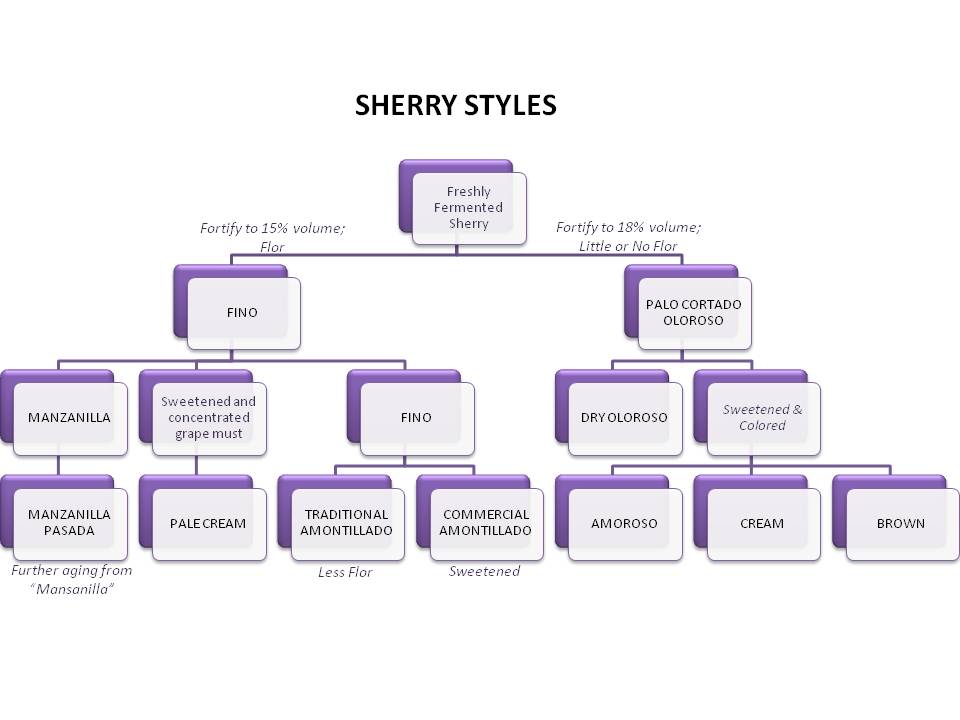
I found this classification chart in my "Total Wine & More" catalog and thought it was so good that a reproduction would be appropriate:
(Chart from Total Wine & More)

The basic classification breakdown in Sherry styles is between Fino and Oloroso.  With Fino, the alcohol fortification is usually lower than Oloroso and is produced with a greater influence of flor, or the naturally occurring yeast that forms on the surface of the wine.  With flor, the wine does not undergo as much oxidation as it is protected by the yeast.  You can see this first break in the chart above.  Oloroso, on the other hand, has a higher alcohol content (greater fortification) and is matured without flor.  The absence of flor allows for a greater oxidation, deep brown color, and richer nutty and raisin-like flavors.

Most Sherries are started with Palomino grapes, which have very little flavor and are low in acid (or have a high pH).  These grapes are ripened excessively to obtain a high sugar content (which is converted to a high alcohol content) and left to shrivel in the sun after picking.  Traditional Sherry includes a gypsum addition.  The actual scientific reason for the gypsum (or calcium sulfate) addition is yet to be fully explored, but we know that gypsum reacts with potassium bitartrate to produce calcium tartrate (which is insoluble), potassium sulfate, and tartaric acid.  Additionally, it encourages the growth of the flor yeast.  As Sherry is aged, the wine is racked off from the precipitate, or the insoluble components.

File:FLOR-ValdiviaJerez59.jpg
I really like this picture from Wikipedia that shows the flor yeast (the tan layer near the top of the barrel) and Sherry precipitate (tan layer in the curved part at the bottom of the barrel)

Sherries are aged in a solera system, which is essentially a "fractional blending" system.  The solera represents how complicated and time consuming Sherry can be.  In the most simplest explanation, the oldest or longest-aged Sherry is drained from the bottom of the solera.  This Sherry is then used for blending and bottling.  To refill the bottom stage, Sherry from the stage above it is drained and divided into all the barrels below.  This goes on and on up the pyramid.  When the top stage is drained and divided, it is refilled with fresh Sherry or Sherry being stored in the "nursery."  The bottom graphic from australiawine.com illustrates this explanation:


Food Pairings with Sherry:
1) lobster bisque (good with Fino Sherry)
2) cheesecake
3) vanilla ice cream
4) mixed nuts
5) puddings
6) very garlic foods (good with Oloroso Sherry)
7) foie gras
8) light blue cheeses (good with Fino Sherry)

Sherry Producers to Try (Thrifty, yet Fun!):
1) Osborne ($10 - $16 depending on Sherry style)
2) Don Benigno (~$10)
3) Harvey's Bristol Cream Sherry (~$12; a good introductory, sweet Sherry)

Thursday, October 28, 2010

Wine Ed 411: Wine Styles - Dessert Wines (Sweet, Not Fortified)

"Dessert Wines" usually do not receive the respect they deserve.  Truthfully, many dessert wines are intricately made and processed with much care and time.  These wines are usually sweet (with some residual sugar aka sugar left over from fermentation) and with a good, crisp acidity to balance the high sugar content.  Below are several dessert style (non-fortified, meaning, without the addition of distilled liquor) wines.

Sauternes
This style used to be very popular and in the recent years has slightly dropped in popularity.  Regardless, it is still a very complex wine.  Botrytis-infected berries are hand-picked during the late harvest season.  Botrytis is a mold that in wet conditions causes a spoilage of grape berries.  While in dry conditions Botrytis causes a dehydration and flavor concentration of grape berries.  In the case of Sauternes, Botrytis is formed under dry conditions, which is commonly labeled as "noble rot."  Typically, only Sauvignon Blanc, Semillon, and Muscat grape varieties are used for Sauternes.  Once the berries are harvested, they are then pressed and put immediately into barrels.  Fermentation is slow and usually stops around 13 to 14% alcohol, max.  The fermented wine is then stored in new oak barrels for about 3 and a half years before bottling.  

noble rot

As a region, Sauternes is located about 25 miles southeast of Bordeaux in the Graves district of France.  Sauternes, as a wine, is rich in flavor with a noticeable honeyed flavor accomplished by Botrytis.  The wine is also very sweet.  The most recognized Sauternes in the world is made by Chateau D'Yquem.

Tokaji (Tokay)
Tokaji is in a class all of itself.  These wines, which have some of the longest history known to the world of wine, are made in Hungary primarily from the Furmint variety.  Additionally some degree of Harslevelu and Muskotaly varieties may be added.  Again, grapes are infected with Botrytis, concentrating flavors and sugars in grape berries.  A thrifty Tokaji: Disznoko Tokaji Aszu 4 Puttonyos ($30 for 500 mL), with lots of honey, spice, apricot, and citrus flavors. 

Trockenbeerenauslesen
Made in Germany, primarily from the Riesling variety, these wines are quite delicate and pleasant.  Unlike it's counterparts, Trockenbeerenauslesens never see oak, and alcohol content is usually much, much lower than a Sauternes.  Additionally, wines are usually crystal clear, as they experience some level of filtration prior to bottling.  In my time, I have tasted several different levels of German wines.  The Trockenbeerenauslesen wines are usually the most expensive, but oh so different and unique from any other dessert wine out there.

Icewine (Eiswein)
The principle is the same.  Here, sugar is concentrated by desiccation of berries due to freezing.  Grapes are left on the vines to hang long into the winter months and picked with ice surrounding them.  Fermentation is slow and cold, but the result is a sweet, acidically balanced wine.  New York and Canada have popularized Icewine fermentations, and I have to admit that tasting several Icewine varietals for a dessert is quite pleasant.  I remember this experience in Florida (far away from ice) where a flight of 5 Icewines were put in front of me for dessert.  It was fabulous.  I had expected many of them to taste the same, but the variety and unique nature among each icewine was superb!  If you ever are in need of a fun dessert, splurge on buying 4 or 5 different icewines, serve as a flight (each person receives a glass of each... remember, use smaller glasses for dessert wines), and taste each one right after another.  Your guests will not be disappointed. 

Icewine Harvest in Ontario (Photo from The Washington Post)

Cryoextraction
Cryoextraction involves manually freezing grapes to concentrate sugars, acid, and flavors much like icewine.  The difference is that grapes are picked, then frozen as opposed to left hanging on the vines during the freezing months.  There are some great dessert style wines out there that are cryoextracted (or I believe they are).  Check out Linden Vineyards Late Harvest Vidal and Late Harvest Petit Manseng and Veritas Vineyard & Winery Kenmar, which has received much attention recently.

Food Pairings with "Dessert Wines":
Generally speaking, match the color of the dessert wine with your dessert!
1) By itself
2) cheeses (especially blue cheeses and soft cheeses)
3) fresh fruits (especially white fruits like pears, apricots, and peaches)
4) foie gras
5) pates
6) smoked salmon or smoked mackerel
7) shellfish
8) ice cream
9) cheesecake
10) puddings
11) fruit tarts
12) chocolate (head caution with this one - chocolate is usually paired better with ports and brandy, but... I'm throwing this in here for entertainment!)
Doesn't this just make you want dessert???


Wednesday, October 27, 2010

Wine Ed 411: Wine Styles - Whites with Body

As with "Light, Aromatic Whites" the emphasis here is on the "body" or "mouthfeel" of the wine and degree of oak that influences the white wine character.  The best comparison in "mouthfeel" is to taste a stainless steel fermented Chardonnay (that has not seen oak at all) versus a Chardonnay, of the same vintage year, that has been heavily oaked.  The stainless steel Chardonnay should taste thinner, brighter, and more acidic than the oaked Chardonnay.

Many original Chardonnay-lovers love this "White with Body" style: lots of oak flavors, buttery, butterscotch, caramel, vanilla, smooth, and crisp acidity.  I'm sure those Chardonnay-ers out there know what I'm talking about.  But there are varying degrees of oak that can influence the flavor profile of a Chardonnay... or any wine, really.

The level of oak places a big part in these varieties.  The touch of oak allows not only for oxygen integration into the wine to smooth out any tannins and enhance the "mouthfeel," but it can also integrate specific oak-like flavors in addition to the varietal (grape) flavors.  Additional flavors and "mouthfeel" alteration comes from the completion of malo-lactic fermentation, which is a secondary, bacterial-based conversion of tart, harsh malic acid (think green apples) to a less tart, softer lactic acid (think milk).  However, some of the buttery flavors develope in the wine as a bi-product from the bacteria.  This, of course, is a very broad explanation, but you can see here that the focus for these "Whites with Body" is the integration of oak and expression of malo-lactic fermentation versus the "Light, Aromatic Whites" which express primary grape aroma and flavor characteristics as well as their natural acidity.

Heavily oaked Chardonnays are an extreme of this style.  I encourage you to reach out and try some other versions of this style, using different varieties.  Check out a white Burgundy (which is Chardonnay), Viognier, Sauvignon Blanc, or even a Petit Manseng if you are lucky enough to find one.  A list of varieties follows.


(Photo by Author)

"Whites with Body" Varieties:
1) Chardonny (this is especially true of Chardonnays that have seen oak; Burgundy, France produces some lovely Chardonnays)
2) Sauvignon Blanc (The Bordeaux style of Sauvignon Blanc that is produced in Bordeaux and California, especially Napa, are "Whites with Body."  However, I'd have to say that a New Zealand Sauvignon Blanc is more a "Light, Aromatic Whites")
3) Semillon (the cousin to Sauvignon Blanc; primarily used as a blending grape with Sauvignon Blanc, but Australia produces some varietals)
4) Viognier (this variety can be made in many different styles, either with or without oak.  I recommend an Eastern U.S. Viognier, especially from Virginia.  Check out White Hall Vineyards and King Family Vineyards.  There are also some good Viogniers that I've tasted in California, one of them in particular Amazon Ranch)
5) Petit Manseng (a French varietal that is getting some popularity in the Eastern U.S., and one of my favorites.  Can be made with oak or as a dessert style.  I recommend White Hall Vineyards, Chrysalis Wines, Horton Vineyards, or Linden Vineyards and Veritas Vineyard and Winery for a dessert style.)

Food Pairings with "Whites with Body" Wines:
1) vegetarian dishes
2) chicken
3) turkey (think Thanksgiving with a nice, oaky Chardonnay)
4) pork
5) game birds
6) spicy Asian cuisine
7) Chinese
8) white sauce pastas
9) pizza (yes, pizza - how about a white pizza? or pizza with spinach?)
10) fish (i.e. salmon, trout, shellfish - the "heavier," "meatier" fish)
11) fruits
12) soft and hard cheese (this is really going to depend on the level of fruitiness to oakiness and richness of flavor and body overall)

Wine Ed 411: Wine Styles - Light, Aromatic Whites

I think I will embark on a journey through wine styles.  Not only will this help me learn more about winemaking techniques to express such styles, but I also hope to educate you on what is out there.  My wish is that it will make it easier for you, the reader, to understand all those different types of wines and feel more confident when purchasing wine.  

I have learned over the years that many consumers do not feel comfortable buying wines in many situations (i.e. at a restaurant, for a group of friends, at a wine store, at a winery, etc.).  Maybe this is because the wine industry requires us, the consumers, to fully understand what we are buying.  Had I not started this journey into the wine world 10 years ago, I would have to say, I'd be clueless.  There are so many things that are marketed in a bottle and so many different selections that looking at a wine section in a grocery store, state store, etc. is in and of itself, overwhelming.  However, with a little bit of knowledge, I can help make the experience a little less traumatic.

So let us start with "Light, Aromatic Whites," which is (I think), a very good place to start.  This is often where many wine drinkers initiate their wine drinking experiences.  It is the easiest style to adjust to, usually quite pleasant regardless of variety, easy drinking by itself or with food, and somewhat easy to find.  (One should note that if you have sulfur dioxide allergies, white wines are probably not for you and will probably elicit sharp headaches when drinking.)

(Aromatic White - Photo taken by author)


The term "light" refers to the "body" or "mouthfeel" of the wine.  What does this mean?  "Mouthfeel" is essentially how the wine feels in the mouth.  Is it full (viscous, have a syrupy texture) or light (watery, thin)?  Surely the best way to understand this term is through an example.  Water is, obviously, light bodied.  In comparison, corn syrup, maple syrup, or chocolate syrup is very viscous and will feel heavy (full) in your mouth.  This sensory sensation can often be felt mid-tongue and on the sides of one's mouth.  For a better understanding, try sipping each one of these examples.  Both foods have different textures, and these textures are reflected in wines.

In winemaking, some varieties can handle more "body" or "mouthfeel" than others.  Sometimes this is represented by the variety itself (based on the grape genetics and composition) or the style of winemaking (i.e. using surli or barrel aging vs. not).  However, both of these examples can often impart several different types of "mouthfeel" sensations and flavors... which just gets too complicated in this introductory lesson!  However, a good general comparison for "body" or "mouthfeel" in wines is to taste a non-oaked (or stainless steel fermented) Chardonnay vs. an oaked Chardonnay.  Many wineries will feature both, especially in the Eastern U.S. as the stainless steel Chardonnay has become quite popular.  (If you are out wine tasting and you see Chardonnay on the list, I encourage you to ask for details!)

 (And for the winos out there, I know Chardonnay is not usually classified as a "Light, Aromatic White" wine, but I think the comparison serves a purpose for mouthfeel understanding.)

So for a "light" wine, especially with whites, many have a texture that is more reminiscent of water than corn syrup (for generalization sake).  Additionally, as many "light, aromatic whites" are not oaked, there tends to be a lack of additional "mouthfeel" or structure from oak components.  And many "light aromatic whites" have a very crisp acidity (sourness) that makes that great for food pairing.  

The term "aromatic" refers to the aroma and flavor profile of the wine.  Aroma is in reference to what you smell before drinking any of the wine, although some people "smell" better when the wine is their mouth (this is essentially flavor) compared to smelling directly from the glass.  "Aromatic" varieties often have very profound, distinctive smells emanating from the glass.  Such varieties have unmistakable aromas and flavors, which originate in the grape.  Again, generally speaking, although not always true, "aromatic" varieties are not usually oaked, and would, therefore, only contribute varietal fruit aromas and flavors. 

Several "Light, Aromatic White" Varieties:
1) Non-oaked Chardonnay
2) Riesling (found in New York, Alsace, France, and Germany)
3) Gewurztraminer (cousin to Riesling; Pennsylvania is producing more Gewurz these days)
4) Pinot Gris or Pinot Grigio (they are the same thing; can have some oak, but generally light bodied; found throughout the U.S. and Italy)
5) Chenin Blanc (I encourage everyone out there to buy a bottle of Vouvrey (which is a part of the Loire Valley in France that is famous for their Chenin Blanc: Thrifty Vouvray's (Chenin Blanc) at Total Wine)
6) Muscadet (aka Melon de Bourgogne)
7) Gruner Veltliner
8) Trebbiano
9) Marsanne
10) Roussane

Food Pairings with "Light Aromatic Whites":
1) salads (if one can pair a salad)
2) spicy Asian cuisine
3) Chinese
4) Vegetarian meals
5) white sauce based pastas
6) fish (including things like shellfish, oysters, and octopus)
7) pork
8) fruits (as these wines are very fruity... usually)
9) goat cheese, Feta cheese
10) or drink by itself on hot summer days

Friday, October 22, 2010

Wine Buzz: What's your favorite??

I think it is always important to share what everyone is drinking and get a feel for what the people like!  So I will routinely ask for your input. 

Please list YOUR current wine of choice with any details that you would like to share in the "Comments" section.  If I can find the bottle, I will try it and post about it in the near future.  :)  Cheers!

Thursday, October 21, 2010

Tasting Room Treasures: Meadowbrooke Gourds

Decorate your home with "Wine Country Style" - visit: http://www.gourdshop.com/.

I found these precious decorations in a Napa Valley store and absolutely fell in love with them.  They represent the quintessential Wine Country style for holiday decor.  It brings that natural, classy, country look to any home in any part of the U.S. 

What I absolutely love about Meadowbrooke Gourds is that each individual gourd is hand crafted from start to finish (including the paint!) in Carlisle, Pennsylvania.  I have to show off the representation of Pennsylvania crafts in Wine Country, USA!  I think this is fabulous!

Such additions would be perfect for Pennsylvania winery tasting rooms.  These are fun, seasonal items, that match the fun and sophistication of wine.  And, oh, so cute!

My first addition to my Napa Valley home was "Traditional Jack."
Halloween Traditional Jack O Lantern Gourd
(All photos from Meadowbrooke Gourds)

But here are some of my favorites:
Halloween Black Cat Raven Small
Raven Small

Candy Dishes
Fall Candy Dishes!

Casper Jacks
Casper Jack Ghost Gourds

Vine Luminary
Vine Luminary 
(Perfectly matched to all those grapes hanging outside!)

Maple Leaf
Maple Leaf Gourds

Bears
The Bear Collection

Jolly St. Nick
The St. Nick Christmas Collection

Ornaments by Jessie
Ornaments by Jessie Gourds

Abby
Abby 

Murphy Lit Gourd Dog
Murphy

Tuesday, October 19, 2010

Wine Buzz: 2009 Sauvignon Blanc by Provenance Vineyards

It's been awhile since I had a good wine pick, and as I'm flooded with California wines these days, I found a rather nice one.  It was quite a surprise to see this bottled in a screw cap, but if consumed within the next 2 years, I believe the freshness should be of equal standing since we tried this bottle.

Provenance Vineyards Sauvignon Blanc Rutherford 09


The D-2010 Scale! (I need to copyright this...)
2009 Sauvignon Blanc by Provenance Vineyards (Rutherford) 
Appearance (10 points possible): pale yellow color, clear - 10 points
Aroma/Bouquet (20 points possible): immediately get grapefruit and fig-like character, lychee, pears, white peaches, slight melon and cream  - 20 points
Taste (10 points possible): fruit forward, but medium-bodied in the mid-palate with the creamy texture and a lengthy, smooth finish.  citrus fruit flavors linger in the finish, with slight bitterness in the tail, but hidden well when paired with food  - 9 points
Balance (5 points possible): perfectly balanced - great fruit, but not overly fruity and grassy like a New Zealand Sauv Blanc and not overly oaked like some Napa Sauv Blancs - 5 points
Finish (5 points possible): Lots of fruit in the entry, but the finish completes this wine with lingering fruit and creaminess. - 5 points 
Add 50 points for attempt, packaging, closure, etc.
Total Points: 99
Overall Thought: I absolutely LOVED this Sauvignon Blanc.  For me, this is the perfect style of Sauvignon Blanc.  I like the small hint of oak that is well integrated and not over powering.  The alcohol level is not super high, which is impressive for a Napa Valley wine.  Although I enjoy New Zealand style Sauvignon Blancs, I enjoy the extra depth and structure given from the oak, which is more like a Bordeaux style Sauvignon Blanc.  Lots of fresh fruit, but sophistication underneath it all.
Food Pairings: Ahi tuna, pork, wasabi dressings, or drink on its own
Cost: Listed at $22.00
Splurge Factor (out of 4): 2 - it's in the the $20 to $30 range, so I'll up the splurge factor, but a very good Sauvignon Blanc to splurge on
Where to buy: Order online if you can (otherwise, I'm hoping it's distributed throughout the U.S.): http://www.provenancevineyards.com/index.cfm

Monday, October 18, 2010

Wine Party: Throw a Masquerade Ball

I've been really into the recent winery trend of throwing Masquerade Balls as festival events.  On a recent search, I found wineries in Iowa, North Carolina, California, and Oregon throwing October-based Masquerade Balls.  In North Carolina, the event even included a murder mystery (to go with the Halloween theme, of course).

This got me thinking... a lot of people I know are trying to find fun ways to incorporate wine into a social gathering.  So, part of the purpose of this blog is teaching you (the reader) how to make wine a part of your fun, too.  Hence - here's how to throw a wine-based, (thrifty), Masquerade Ball.  After all... sometimes we all need a little fun.  :)

First, some pictures of several styles of Masquerades (all pictures off Google Images):
Phantom of the Opera (the movie) Masquerade

Marie Antoinette

Van Helsing


So... you get the point.  Extravagant - dancing - elaborate costumes...  But we can bring it all together and focus around the wine!  In this current economic state, I've seen a lot of parties thrown when the guests contribute.  It seems to be well received.  I would decide if this is something you are up for, and then choose what it is that you would like guests to bring vs. what you would like to supply.  

A perfect Masquerade Ball theme for October season involves the colors black, deep purple, and silver.  I think this matches perfectly with the Halloween/Harry Potter-esque themes.  Color is everything with a Masquerade.  :)

First is first - the dress.  I recommend making it a black-and-white dress type of occasion.  This eliminates the need for guests to buy costumes during an inflated price season.  Black and white colors set the tone, and keep the spirit of October alive.  I would make it clear that the dress is semi-formal with several examples of what is appropriate.  After all, Masquerades were meant to be fancy!  Then comes the decision on whether guests should provide their own masks or if you would like to provide some at the door.  Either way is acceptable and both can be fun.  If you choose to have guests bring their own masks, I would provide some fake jewelry or accessories at the door to say "thank you" to your guests.  Here are some links to Masquerade masks that I found on a brief Google search:

Decor - to me, the black, deep purple, silver theme is perfect.  You can easily decorate with this.  Simple things that you can find that add a touch of magic, mystic, and elegance include mirrors in old vintage frames (white and black colored frames), pillar candles (of all shapes and sizes), and gossamer fabric, which adds a touch of shimmer no matter where you put it.  Drape it over furniture, the table, and even tie bows around the dinner chairs.  It's a thrifty decoration piece.  I've also heard that chilling your candles in the freezer will allow them to burn slower and longer.  Candles are a great mood piece here, as it really dims the lighting; perfect for a Masquerade.  A simple outdoor decoration is in season right now - pumpkins!  I would recommend some white pumpkins (the smaller the better), and hollow out enough of it to light with small candles.  As guests arrive, they'll be amazed at this small touch.  Even better - add some glitter to the pumpkins to really make the walk way sparkle.  This theme could be transfered inside as well, for extra decor.

For the table, line with dark purple or black paper table lining.  Adjust a layer of gossamer fabric over top of the dark backdrop.  Candles, shimmering pumpkins, and some food will make this the perfect set up inviting guests to enjoy some food and wine.  You can also opt for some floating candles - they are very trendy these days and do add a touch of elegance.  Placing these items on flat mirrors (which you can purchase at many craft stores such as Michaels, discounted shops like Ross, T.J. Mazz, or Marshals, and places like World Market) gives a glowing effect that is perfect for your Masquerade Ball.

Food and Wine -  Now, the tricky part.  It's up to you to decide whether you want a real sit down dinner or a bunch of tiny hor d'oeuvres for people to snack on.  I'm definitely a proponent of hor d'oeuvres - it's easier and allows guests to graze freely.  I definitely think it's worth investing in some fruit and cheese platters.  After all, you will be enjoying some wines throughout the evening.  Dark purple grapes, plums, figs, and apples are perfect for the theme and season.   Add some cheese and crackers (choose to your liking) on another platter. Additional food fillers includes specialty breads, assorted meats, olives (dark olives would look great here), roasted lightly-spiced pumpkin seeds (from all those hollowed out pumpkins!), and a dark leafed salad.  I'd complete the meal by adding in some dark chocolate dessert.  My favorite would be little dark chocolates adorned with silver foils.  But nowadays, you can also opt for the dark chocolate Hershey Kisses, which come pre-wrapped in dark purple foil.  Using paper plates, silverware, and napkins is perfectly acceptable and will be an easy clean up.  See if you can find some in black.  

The wine is a bit tricky.  You can purchase plastic wine glasses and tag with people's names, or have everyone bring their own glass, but you must specify what kind of wine you will be serving.  If guests bring their own wines, you can provide wine glass tags or charms at the door to make sure guests leave with the same wine glass.  Wine glass charms could be a perfect party favor for your Masquerade Ball.
Paper Wine Glass Tags
Gemmed Wine Charms
Teardrop Wine Glass Charms

Or there are those fun plastic wine glasses:
Light Up LED Acrylic Wine Glasses set of 6 colors


Regardless, picking a wine is essential.  When it comes down to it - this is a wine party.  If it was my party, I'd serve bubbly.  I think it fits in with the essence of a Masquerade.  Of course, with bubbly, it is essential to have plenty of food and designated drivers (or rooms where people can spend the night).  An extra thrifty note is that a little bit of bubbly goes a long way.  So you can buy a fine assortment of sparkling wines and please a crowd.  In addition, there are several sparkling wine mixed drinks out there that may capture the feel of the night.  Sparkling wine can be placed in tin tubs (filled with ice), which continues to mingle with the theme.  Some thrifty sparkling wines: try Korbel (depending on the style and variety, ~$10-12 per bottle), Freixenet ("fresh-eh-nee") Cordon Negro Brut and Extra Dry ($9 or $11 per bottle and this sleek black bottle goes very well with the Masquerade theme; remember, "Extra Dry" means the wine is sweeter than "Brut"), Yellow Tail ($9 per bottle), Gloria Ferrer (the Blanc de Blanc is often <$15 a bottle in Eastern states), Domaine Ste. Michelle Brut ($10 per bottle), Presto Prosecco Brut (~$8 per bottle), and Andre Spumante ($6).  Of course, these selections are assuming national availability as well as being budget friendly and general crowd pleasers.  If you are in the mood to splurge, take a look at my previous blog on Mumm Napa Brut Rose as a magnum (Brut Rose by Mumm Napa) or Blanc de Chardonnay, Brut by Thibaut-Jannison (Blanc de Chardonnay).


To top it all off, offer sparkling water.  Bubbles, bubbles everywhere...


The rest is up to you!  Improvise with music, which you can play right off an mp3 player, games (hmmm... like "Clue" or card games), or old thriller films.  The activities should focus on you and your group of friends - what you enjoy doing.  Most of all... enjoy! 

Friday, October 15, 2010

Wine Book to Read: Secrets from The Wine Diva by Christine Ansbacher

In a recent conversation I was having with a Sommelier friend of a mine, I realized that there are probably 2 types of wine educators out there: those that love the pretentiousness of wine and those that love to teach about wine (and enjoy it).  That has led me to introduce this book, Secrets from the Wine Diva, that exemplifies the use of "fun wine teaching" and enjoyment of it.

[A Sommelier, for those who are uncertain, is a wine professional that specializes in wine service and food and wine pairings.  You often see these professionals in high end restaurants, especially when a wine list is presented as you take your seat.  They are very fluent in wine varieties, regions, styles, etc.]

Anyway - back to the purpose of this blog, which is about Secrets from the Wine Diva!  We used to joke about this little guide while I worked in a winery years ago, but I found that it's the optimal size and perfect language for those who want to feel more confident in their wine purchases.  And it's fun!  (Always my favorite thing about wine...) 

The guide covers everything from expanding your wine education, purchasing wine at restaurants, pairing wines with foods, shopping for wine at the grocery store, creating your own "wine cellar" (of all sizes and magnitudes), and planning wine-based travels.  I really love this guide!  It not only explains how to say certain wine words, but also lists tips to remembering wine words.  For the most common varieties, Christine highlights typical mouthfeel styles (i.e. light, medium, or full bodied) and how those styles are associated with food pairings.  For anyone that wanted to understand wine, feel confident making wine purchases, or needed extra help throwing a wine party, Secrets from the Wine Diva is an excellent choice got get started!

Secrets from the Wine Diva: Tips on Buying, Ordering & Enjoying Wine
(Picture from Amazon.com)

The book appears targeted towards women, but there are also very many useful tips in here for men.  (Maybe just buy the book for your lady friend and sneak peaks whenever you need to use it! ;)  And for all those single guys out there, knowing a thing or two about wine helps to impress the ladies...)  

Another great point - it's thrifty!  Sticker price is $14.95, but of course, there's always a bargain out there somewhere.  Amazon.com features this book for under $11: http://www.amazon.com/Secrets-Wine-Diva-Ordering-Enjoying/dp/1402730365/ref=sr_1_1?ie=UTF8&s=books&qid=1287165716&sr=8-1

Cheers everyone!