Wednesday, January 11, 2012

Winerd: The Game

Here's a clever way to get a bunch of your friends together and enjoy a few sips of wine: Winerd, The Game!

winerd-game.jpeg
(Photo from Outblush Website)

I can't really give this came ultimate props because I've never played it, but there was a trial run on the Today Show featuring Kathie Lee Gifford which was hilarious: Today Show Winerd Video.  If that doesn't put you in a good mood on Thursdays, I don't know what will!

Regardless, what a fun game AND you learn something!

(Photo from Google Images)

My suggestion... get one of these for your friend's birthday!  You can purchase on Outblush for just $23 or Barnes and Noble for $23 to $32.  I think this would make the ultimate Thursday night wine tasting party... fun and thrifty...

(Photo from Google Images)

Tuesday, January 10, 2012

Q: I've Never Had Wine Before, What Should I Try?

Answer:

Most people that taste wine for the first time prefer a chilled, sweet wine.  This makes sense!  Humans are genetically pre-disposed to enjoy sweet, sugary things.  (No wonder Coca-Cola and Pepsi are so popular!)  ;) 

But many people also feel embarrassed to admit that they like sweet wines, especially to other people that are "more regular" wine consumers.  But don't despair.  Someone that makes you feel stupid for drinking wine is just a wine snob... and who wants to drink with them anyway?!  

Besides, the majority of wines on the market all contain some level of sweetness.  Why?  Because large winery conglomerates know and understand that most people prefer some sweetness in their wines.  This small addition of sugar guarantees that people will like the wines they produce, and, therefore, come back to buy the same wine again. 

Here are my suggestions (put in no particular order) to get yourself acquainted with wines that you may like, and still look like a professional wine connoisseur!

1) Moscato or Moscato d'Asti (same thing!)


This is the hot new wine variety, especially being pushed by Gallo.  This white variety is incredibly fruity, grapey, and has a slight fizz that makes this wine so approachable and enjoyable.  Drink this wine chilled.  Any time there is noticeable sweetness in the wine, it is preferred to chill it.  The best part: this variety is not going to break the budget!  This is a perfect summer wine, so if you want to impress those "wine snob" friends of yours, this is the type of wine you bring to a family picnic, a pool party, or the 4th of July holiday celebration.  But if you love this wine, you can sip on its pleasantness all year long... :)

Producers I recommend: Barefoot, Gallo, Cupcake, Martini & Rossi Asti Spumante, or try a featured favorite from you local wine store!

2) White Zinfandel

This is the wine that made California's wine market.  Why do you think it's so popular?  It's fresh, it's fruity, it's sometimes bubbly, slightly sweet, and very pink!  A local hit among young drinkers breaking into the wine scene, this wine is "where it's at."  Anyone can love this wine, but when you feel like moving onto something new, I recommend the Moscato (see #1).  

This is often sold in a bulk wine size (1.5 L bottle), but you can buy it in a 750 mL (normal) wine bottle size. I recommend this wine for parties and get-togethers when others aren't as familiar with wine, and you are looking to introduce them to wine drinking.  Again, serve chilled.

Producers I recommend: Sutter Home, Beringer, Beringer (Sparkling), Beringer (blend), Gallo, or try a featured favorite from your local wine store.  This is a very popular style to make among many different wine regions.  Open up your taste buds, and give these a try!

3) Fruit Wines


There are many, many fruit wines out there on the market (i.e. blueberry, raspberry, cherry, mango, etc.).  Depending on the producer, these come in a wide variety of flavors, sweetness levels, and styles.  Some are grape based with added fruit (usually very yummy) and others are 100% the fruit as labeled.  This may require some extra work for you to pick and choose your favorites.  You may have to have some patience in figuring out your tolerance with fruit wines.  One blueberry wine can taste wildly different from a blueberry wine produced at another location.  Again, I always serve these chilled.

Side note: If you hate the fruit wine as is, I recommend making a red or white sangria out of it!  This seems to always work.  :)  And then serve it at your family summer picnic!

Producers I recommend: Bonny Doon (look for the "?Querry?" in the Whites, or "Raspberry Eau de Vie" in Desserts), Seven Mountains, Maiolatesi, Keel and Curley, Boones Farm, or try a local favorite!  

4) Riesling

Riesling - made most popular over the past few years by Washington's one and only Chateau Ste. Michelle. Peachy, citrusy, honied... this is beautiful variety!  The best part about Riesling is that it's coming "back in style" meaning many wine drinkers of all experience levels are picking up bottles and sipping away on this versatile variety.  The confusing part about Riesling: it comes in a variety of sweetness levels... which means you have to pay attention to what you're buying.  Riesling can be anywhere from bone dry (i.e. no sugar) to very, very sweet (i.e. ice wine, late harvest).  This will take some experience to figure out where your preference lies.  But don't be afraid to go outside your comfort zone and try some of those low alcohol (<10%) German Rieslings.  You'd be amazed at how beautiful they are!

As Riesling is usually produced in cooler-climate, rainy regions, I feel like it's appropriate to say this is your rainy-day kind of wine.  Any time you need a pick-me-up, grab a Riesling - it's a "feel good wine."  I don't know how anyone can be in a bad mood sipping on this wine.  :)  Give it a try sometime soon! 

Producers I recommend: Chateau Ste. Michelle, Columbia Valley (sweet!!), Chateau Ste. Michelle, Ethos (very sweet!!), Blufield (semi-sweet), Ravines (dry!!), Pacific Rim (semi-sweet), or try a local favorite - there are LOTS of Rieslings out there!

5) Chardonnay

Ahhh, there we go... now we're getting into the big boys of wine drinkers!  But you need to know where to start with these, and the various selection in a wine store can be more than overwhelming.  If you've never had Chardonnay before, and are transitioning from a Moscato to this variety, the difference in taste can be revolting.  There are few brands on the market that are generally well-received by consumers, which is what I'll list here.

It's important to remember that Chardonnay comes in a variety of styles, the two most prominent are "oaked" which display large vanilla, buttery flavors, and "unoaked" or "naked" which emphasize the apple, citrus flavors from the grapes.  Most people prefer one style over the other, but generally speaking, I've found both styles to be quite pleasing depending on the occasion, meal, and what kind of mood I'm in.  :)  Again, this variety may take some patience to figure out what you like... start with the lower price point wines and work your way up.  We'll be surprised what you will find.  (Again, serve chilled!)

Producers I recommend: Cupcake (vanilla tasting), Kim Crawford (unoaked Chard!), Menage a Trois (oaky and buttery), Columbia Crest (slightly oaky), Clos du Bois (less oaky), or check out some of the local favorites in your nearest wine store!  There are lots of Chardonnays out there...

6) Zinfandel... the red kind!

Red wine is a bit more difficult, as most red styles are drier (which means, little sugar).  Zinfandel is usually found pleasing for those that are trying to switch out of the more sugary wines.  I think this is because Zinfandel is what us wine people call "a fruit bomb" - it's got a TON of fruit in your face from the minute you smell it to the very last sip.  Zinfandels are also made at higher alcohol levels, which gives the perception of some sweetness.  (Yes, alcohol does carry a sweet sensation!)  Here are a few of my recommendations, and I'd serve these at room temperature (think 68 degrees Fahrenheit)... so if you're outside on a hot summer day, this may require minor chilling prior to serving.  I'd recommend this as a late night wine.

Producers I recommend: Ravenswood, Cline Cellars, Clos du Bois, Michael David, and Gnarly Head... among the many Zinfandel producers that may be recommended by your nearest wine store!  (Don't forget that "Primitivo" is the same thing as Zinfandel, so don't get offended if this wine is recommended to you.)  :)

Monday, January 9, 2012

Come See Me Talk About Pennsylvania Wines!

This year marks the 10th anniversary of the Pennsylvania Wine Society's "Pennsylvania Wine Excellence" wine tasting event.  The Pennsylvania Wine Society (PWS) is a non-profit organization that focuses on wine enjoyment: learn the winemaking process, how to select wines, and how to pair wines with foods. 

Previous PWS Award Winner, Pinnacle Ridge Winery
(Photo from Google Images)

On Sunday, January 15th (starting at 2:00 PM), the "PA Wine Excellence" tasting will start at the Hilton in Harrisburg.  The event will feature the top 10 wines chosen through a previous wine judging (listing is by alphabetical order):


Allegro Winery & Vineyards Cadenza 2007
Allegro Winery & Vineyards Cadenza 2008
Crossing Vineyards and Winery Cabernet Sauvignon Merlot 2008
Crossing Vineyards and Winery Merlot 2008
Galen Glen Winery Cabernet Franc Lehigh Valley 2009
Manatawny Creek Winery Cabernet Sauvignon 2007
Manatawny Creek Winery Syrah 2008
Presque Isle Wine Cellars Ice Wine Riesling Lake Erie 2008
Vynecrest Vineyards & Winery Chambourcin Estate Lehigh Valley 2010
Vynecrest Vineyards & Winery Cabernet Franc Estate Lehigh Valley 2010


I will actually be the guest speaker for this event, and couldn't be more excited.  There are some phenomenal wines that we will be tasting through the evening!  You don't have to be a wine expert for this event - just a wine lover!  :)  More details are available at the Pennsylvania Wine Society's website.  I hope to see you there!

Pennsylvania Wine Society Logo
(Photo from Google Images)

Friday, January 6, 2012

Friday Wine News You Can Use: What Rising Temperatures May Mean for World's Wine Industry

This was an interesting article that was sent to me via a winemaker.  I thought there were some interesting points noted in this article worth sharing:
1) That the California markets are already noticing increased climatic temperatures.  This has spurred a series of water-wars in addition to constant debates on the quality of high-Brix (high alcohol) wines.
2) Regions that couldn't plant grapes before are now initiating new vineyards.
3) That the change in global temperatures has caused some serious, odd seasons.  2010 and 2011 vintage years were perfect examples of this across the United States.

The original article was posted Yale Environment 360.  It is pasted here for your convenience.

19 DEC 2011: REPORT
What Rising Temperatures May
Mean for World’s Wine Industry
Warming temperatures associated with climate change are already affecting vineyards from France to Chile, often in beneficial ways. But as the world continues to warm, some traditional winemaking regions are scrambling to adapt, while other areas see themselves as new wine frontiers.
by John McQuaid


(Photo from Google Images)

Fifty years ago, English wine was something of a national joke. “Wine making was for the very eccentric. It was drunk as a curiosity and often spat out,” says Richard Selley, Emeritus Professor of Geology at Imperial College, London and author of the book The Winelands of Britain. Wine has been made in Britain since the Romans imported it 2000 years ago. But production declined starting in the 17th century, due in part to cooling temperatures, and all but disappeared after World War I. Modern England’s chilly, rainy climate didn’t provide the minimal number of days of warmth and sunlight that even cooler-weather grapes need to ripen properly and make a commercial product.

Then came climate change. Between 1961 and 2006, temperatures in southern England increased an average of 3 degrees Fahrenheit. English wine came roaring back.


(Photo from Google Images)

Today, there are about 400 commercial vineyards. English sparkling wines are beating their French rivals in international competitions. “We’ve noticed the climate has improved consistently. The weather has improved, the ripening period has become longer, and year after year we’re getting quality fruit,” says Chris White, the general manager of the Denbies Wine Estate in Dorking, England’s largest vineyard at 265 acres. Denbies is anticipating an even warmer future. In 2010 it planted seven acres of Sauvignon Blanc vines, a grape originating from the warmer Bordeaux region of France.

Few products are more sensitive to changes in temperature than wine. So the rising temperatures and associated with climate change are already reshaping the industry.

Production as a whole is moving north (or south in the southern hemisphere) as opportunities open up in once-inhospitable areas. Meanwhile, vineyards in warmer climates are facing mounting problems as it gets hotter. Assuming projections of much hotter world prove true in the next 50 to 100 years, many winemakers will be forced to change their signature products, move, or go under. Many will go under no matter what they do.

Scientists have been analyzing the influence of climate and weather on wine since long before global warming became an issue. Over the past two decades, dozens of studies have mapped the emerging impacts of warming temperatures on vineyards in Europe, the Americas, Australia and elsewhere, and modeled the possible effects over the next 100 years. They paint a picture of accelerating change unlike anything seen before.

“If we look at the best data we have — there’s some data that goes back 500 or so years, and some paleoclimate stuff going back much further — on balance, changes underway today are as big or bigger than anything in those records,” says Gregory V. Jones, a climatologist at the University of Southern Oregon who specializes in climate’s effects on wine.

The wine industry’s early encounter with climate change is a window on the upheavals global agriculture will face over the coming century. It shows how even modest temperature and weather changes can have effects that reverberate through crop yields, business strategies, and economies — and on into culture, traditions, and even the subtle flavors that define national identities.

So far, interestingly, rising temperatures have been mostly good for wine. A 2005 study led by Jones found that the average growing-season temperature in 27 prime wine-producing regions around the world had risen 2.3 degrees Fahrenheit in the previous 50 years. In the vineyards of Spain, Portugal, southern France, and parts of California and Washington state, it rose a dramatic 4.5 degrees. But Jones also found that, in general, wine quality ratings rose with the temperature.

Warmer temperatures in general tend to produce more consistent grape harvests. The heat also hastens ripening, producing grapes with bolder flavors, more sugar, and wine with more alcohol. (This trend has coincided with rising popularity of robust, fruitier wines.)

French wine maker Philippe Bardet who produces Merlot, Cabernet Sauvingon and Cabernet Franc grapes in the Bordeaux region, says that over the past 25 years his harvests have moved from late October to the beginning of September as grapes ripen ever faster. Concerned that this may be affecting the wine, Bardet has tried planting different, slower-ripening grape varieties to push it back. In fact, Jones, in his study, found that some warmer regions were already reaching a heat threshold beyond which quality began to decline.


(Photo from Google Images)

In Spain, changes are now coming rapidly, says Miguel Torres, the president of Bodegas Torres, the country’s largest winemaker, headquartered in Catalonia. “In the last four years, temperatures have increased 1 degree [Celsius] in the vineyards,” he says. “The quality has not changed so far. Our concern is for the future. They say the temperature could go up 2 degrees — or 5 degrees. So we are moving vineyards from sea level to central valley, and from central valley to mountain areas.” Ten years ago, Bodegas Torres began planting vines at vineyards in the Pre-Pyrenees mountain range at an elevation of 1,000 meters as a hedge against climate climate change.

Another looming problem lies not in the vines, but culture and tradition. In many European countries including Spain, Portugal, France, and Italy, wine production is governed by “appellation” systems that tie specific wines to their geographical locations. This is based on the concept of terroir, a French term that ascribes a wine’s uniqueness to the soil, landscape, climate, and viticulture practices of the place where it’s produced. A genuine French Sauvignon Blanc must come from Bordeaux, for instance. But as temperatures climb, it will get increasingly difficult to grow the “right” grapes.

Another study by Jones projected that by 2049, Bordeaux will have reached the upper temperature limits for growing red varieties and will be outside the ideal climate for its white grapes. No more Sauvignon Blanc. The appellation system will put growers in impossible situations — even as it disintegrates.

“Climate change will affect Europe more than other places,” Torres says. “The map of the European appellations will have a dramatic change. If there is a change of 2 or 3 more degrees, where do you place a Burgundy, or a Rioja? What are you going to do? In places like Chile or Argentina, in the Southern hemisphere, you can still go south. Here in Europe, we are demarcated by appellation of origin. If you are from Rioja, the grapes have to come from Rioja.”


(Photo from Google Images)

For the global wine industry as a whole, the challenge is not merely warmer temperatures, but the oncoming, unending rush of change. Another study by Jones projected that the geographical bands suitable for winemaking would shift on average between 170 and 340 miles toward either pole in the next hundred years — a geographically small yet momentous shift. Some regions will become inhospitable to winemaking. Others will have to keep swapping in new varietals. And new frontiers will continually open up.

“If that ground is the best in the world for Pinot Noir, will it be the best for something else?” Jones says. “If Burgundy warms to the point where Pinot Noir and Chablis are not longer the best grapes for that region, will people buy a new product? … At some point a grower in a region that has become too warm has to make a decision. It’s like if you’re selling widgets, and widgets don’t sell anymore, what do you do? You have to come up with widgets 2.0.”

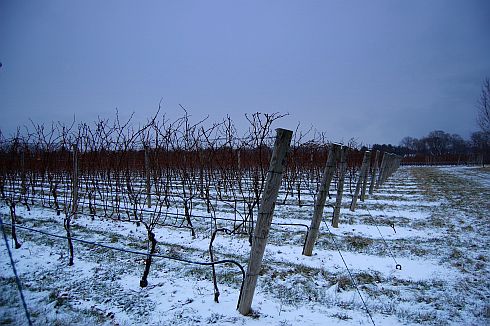
In North America, there’s no 1,000-year tradition of winemaking, so such transitions may not be as difficult. “Emerging regions in the U.S. are trying to grapple with what is the best variety,” says Tyler Colman, who writes the Dr. Vino wine blog. “Long Island, for example. It [the wine industry] has been there only 30 years. They went with reds and thought Merlot was their calling card. But now they’re trying white wines.”

(Photo from Google Images)

But heat is still heat. A recent climate model co-authored by Stanford climatologist Noah Diffenbaugh, Jones and two other scientists suggested that rising temperatures could end up shrinking Northern California’s prime vineyards by half over the next 30 years.

Such dire projections have become a sensitive issue; the Napa Valley Vintners, the wine industry trade association, commissioned a scientific temperature survey to demonstrate that the effects of climate change were being exaggerated. “The results, overall, provide good short-term news that consumers are not ‘tasting’ climate change in Napa Valley wines,” the association said earlier this year. However, the study did show that temperatures had risen an average of 1 to 2 degrees, mostly at night from January to August — a change that Jones says could indeed affect the taste of wines.

Even in Oregon, where the wine industry is expected to benefit from warmer temperatures, climate change is viewed with a mixture of anticipation and dread. Vintners point out that weather is variable — the past few years have been cool and wet — and that climate change is expected to bring more extreme weather events. “It’s a much more complex picture than, ‘on average temperatures are rising.’ If they rise at the wrong time or if weather patterns disrupt the growing season, then the increased degree days are not going to help,” says Don Crank, a winemaker at Willamette Valley Vineyards in Turner, Oregon. Climate change is expected to put other stresses on vineyards as well, including pests and rising competition for fresh water.

Yet Diffenbaugh’s study also suggested that it’s possible to make viticulture far more adaptable, preserving some vineyards and traditional grapes, even as the temperature rises. “We know growers can use pruning practices to increase shading. The orientation of the vines on a given piece of land can help reduce excess heat. Irrigation and trellising practices can be used to cool the plants,” Diffenbaugh says.


(Photo from Google Images)

Tara Holland, an environmental scientist at the University of Guelph in Ontario, Canada, is studying the ability of vintners to adapt to the demands of a changing climate, focusing on the emerging, 10-year-old wine industry in Prince Edward County near the northeastern end of Lake Ontario. There, Holland says, freezing temperatures are currently a problem: vintners must bury vines in the winter. If frost threatens the growing season, they now have to light fires and set up fans to blow smoke through the vineyards to create a warming thermal inversion. So winemakers in Prince Edward County are eagerly anticipating more warming.

Still, one of the principal problems wine makers everywhere will face is basic biology: Vines typically take several years to mature and then produce grapes for decades. Replacing them is both a disruption and a major investment. “I hear all the time, if the temperature goes up, it’s great, we’ll plant Shiraz,” Holland says. “But once you plant a vine, it’s in the ground for 50 years. It’s not an adaptation that’s really possible if you have all your fields planted.”

But overall, Jones says, there’s reason for optimism because the world is a big place, with many potentially suitable sites for vineyards. “Where there is cash involved, people will make it happen,” he says. “Whether they make it happen historically as we’ve known it, or relative to some new system in the future, remains to be seen.”

If the temperature increase is catastrophically extreme, though, all bets are off. “If by 2080 it’s too hot to make wine in southern England, what’s the rest of Europe going to look like?” asked Selley, the British author. “You’ll have to switch to making palm wine.”

POSTED ON 19 DEC 2011 IN CLIMATE CLIMATE ENERGY POLICY & POLITICS SCIENCE & TECHNOLOGY EUROPE NORTH AMERICA NORTH AMERICA

Wednesday, January 4, 2012

A Look at Dreadnought Wines

Upon a recent visit to the Strip District in Pittsburgh, PA, I stopped in a wine shop called Dreadnought Wines.


Entrance into Dread Nought Wines


What a fun place to stop in and look at wine merchandise!  Here's a couple of high lights from my visit:

Fun wine rack with chalk board

These elf-pants wine bottle holders were perfect for the holidays

Classy wine ornaments - red varieties

Classy wine ornaments - white varieties

Fun reindeer bottle covers - great holiday decorations!

Antique knob bottle stoppers - how unique!

Hot or Cold faucet bottle stoppers

A saber to open Champagne the old-fashioned-way...

Marble wine coasters ($40 for 4) - I loved these!

Great educational wine books!

The tasting and education room - a great resource for wine education if you are in the Pittsburgh area
You can find more information about their tastings and classes on their website, here.

Bulletin boards shaped like a wine bottle
(All photos by author)

I love the fact that this store was created as a means to offer Pennsylvania wine consumers an alternative to the PLCB wine purchasing system.  You can read more about their history, here.  They also offer gift baskets that are unique to Pennsylvania in that those wines cannot be purchased through the state stores.  This is accomplished through their partner company, Palate Partners.  This is a real treat for Pennsylvania residents!

I hope that I'll be able to feature more from Dreadnought Wines in the near future!
Written for RSJGPVVJ68CZ claim.

Add "Denise's Press Fractions" to Your Daily Email

Over the next few months, I plan on making some "large" updates to this blog.  (So stay tuned for many big surprises!)  I recently made Denise's Press Fractions available through email subscription, which you can see in the upper left corner of your screen:


I'm hoping that this will make the blog slightly easier for you to get rather than visiting the site every day!  Of course, if you want to visit the blog site every day, I would highly appreciate it.  :)  Cheers!!

Note: If there are any problems, please send me an email at: dmg1214@vt.edu

Tuesday, January 3, 2012

A Look at Total Wine

Personally, I love "Total Wine".  Don't get me wrong, I absolutely 100% support all your local wineries.  But let's face it - there are THOUSANDS of wines out there from HUNDREDS of regions around the world.  What's a wine drinker to do?

Part of the joy and fun of drinking wine is getting a chance to taste a "food" produced around the world in many unique styles.  This is also the biggest challenge of wine retailers.  However, "Total Wine & More" distributors really find a good way to capture your attention.  


On a recent visit to Tampa, Florida, I finally got an opportunity to walk into an actual "Total Wine" store.  Here's what I found:

An explanation of almost each wine, separated by region and style, with some highlighted points.  The example here ("highest quality Beaujolais") is welcoming towards those consumers that would otherwise skip over regions in France.  Most Americans are familiar with Beaujolais Nouveau that comes out every November, but the region, Beaujolais, has lost some steam in our market place.  Here, "Total Wine" not only gives you the typical Wine Advocate or Wine Spectator information, but they also include personal preferences, extra consumer-friendly information, and highlighted points to help you make a selection.

Please also note the incredible pricing.  I bought one of the last bottles of a Burgundian wine labeled "the best example of Burgundy" (in the $20 range).  I asked myself - why not?  :)

Actual photos of the individual wineries/chateaus and photos of the winemaking staff.  This really gave me a feeling that the distributor was very much involved in picking the wines.  As a consumer, I really appreciate this and I think it makes approaching employees there that much easier.  

Please also note the photo of one of the workers (at the bottom of this photo).  That wine was one of his favorites.  Good to know, as most of us make our wine selections off of someone's suggestion!

Nicely piled bottles, adequate information, and special temperature/humidity controlled storage rooms for those high end wines (shown here).  This is how wine is supposed to be stored.  I should note that when you walked into this store, the temperature was adequately chilly, ensuring that the wines are not stored too hot, which ruins them for your consumption. 

Not a wine drinker?  OK!  Several aisles were designated towards craft microbrews and spirits of all kinds!  I loved watching customers in this store - people were actually talking about trying new things and specific flavors associated with their beverages.  It made me feel like wine was just a bit less taboo than I usually feel these days...

Best part of leaving the store?  Grabbing a "Buying Guide" on the way out.  If you've never gotten one of these, you are really missing out!  The guide is filled with tiny explanations and wines/beers of all price points.  You can't go wrong here - there's something for everyone!

Monday, January 2, 2012

Welcome in the New Year with a Fun Wine Accessories Merchant

Here's a fun wine accessories company that's been gaining some publicity: Spit Bucket.  Here's some fun things (wine and cocktail-related!) they have posted on their website that you may be interested in checking out:

VCBox&6
VinoCoasts

CCBox&6
Cocktail Coasts

VDBoxCard01
Vinodote - Wine Notes and Stories

VSArmy015
VinoStops

Needs Salt t-Shirt